Subterranean termites account for the vast majority of structural timber degradation throughout southwest Ohio. These social insects inhabit the soil beneath structural footprints, using specialized moisture-retaining…
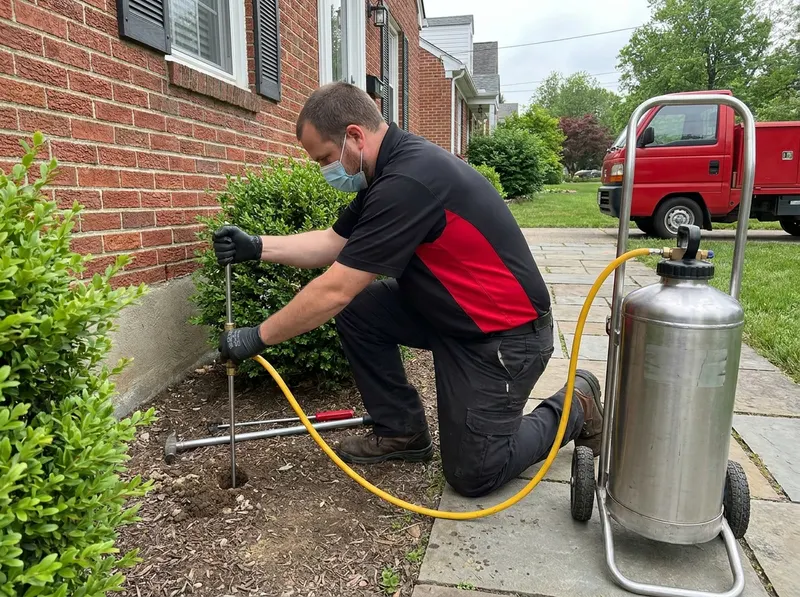
Subterranean termites account for the vast majority of structural timber degradation throughout southwest Ohio. These social insects inhabit the soil beneath structural footprints, using specialized moisture-retaining mud tubes to cross exposed foundation walls and reach framing members. Historic brick row houses in Over-the-Rhine and rubblestone basements in Mount Adams present distinct structural vulnerabilities, as mortar decay provides immediate entry points beneath the frost line. In suburban timber frames throughout Hyde Park, Oakley, and Pleasant Ridge, termites frequently bypass exterior perimeters through expansion joints in attached slab garages and patio abutments. Modern eradication moves away from indiscriminate, high-volume broadcasting, relying instead on precision micro-injections of non-repellent formulations such as fipronil alongside localized structural exclusions defined under the standards of the US Environmental Protection Agency.
Deciding between a complete liquid chemical barrier and an exterior bait station network depends directly on construction design and groundwater access. Liquid perimeter applications create an uninterrupted chemical shield within the soil along exterior footings; this method provides immediate disruption for active, intense structural intrusions in crawl spaces common to Clifton and Northside. However, where mature tree roots, decorative brick paving, or steep hillside grades in Walnut Hills make continuous perimeter trenching impractical, low-impact baiting configurations offer targeted colony elimination without excavation. These stations utilize chitin synthesis inhibitors conforming to the structural pest management protocols of the Ohio Department of Agriculture, destroying the foraging reproductive cycle over several weeks. A liquid barrier guarantees immediate perimeter death zones but requires mechanical drilling through basement slabs; bait systems preserve decorative masonry while taking 60 to 90 days to achieve full colony collapse.
Ashmere Insect Solutions executes eradication through an exact, multi-stage intervention tailored to local building codes and property topography:
Variable soil composition across College Hill and Mount Lookout dictates product performance. High concentrations of dense, unweathered illite and chlorite clays documented by the US Geological Survey impede uniform downward liquid percolation, requiring pressurized sub-surface rods rather than simple gravity feeds. Furthermore, proximity to municipal storm runoff systems and urban streams tracked by the Ohio River Valley Water Sanitation Commission necessitates strict non-leaching formulations that bind tightly to organic matter. For sites near active community green spaces like Eden Park or Spring Grove Cemetery and Arboretum, low-impact formulations avoid non-target soil disruptions. Technicians cross-reference regional timber species performance with data from the USDA Forest Products Laboratory and structural integrity mandates from the International Code Council to verify that treatment zones protect vulnerable white pine and oak floor framing without compromising interior air quality verified by the National Institute for Occupational Safety and Health. Homeowners can reach Ashmere Insect Solutions directly at (513) 812-8078.
Every job gets a firm, written price after an on-site visit.
Tell us about your subterranean termite treatment job in Cincinnati and we'll send a clear, written quote, usually the same day.
 Ashmere Insect Solutions