Ashmere Insect SolutionsAshmere Insect Solutions

Comprehensive Rodent Control and Exclusion Cincinnati

Rodent activity in southwestern Ohio centers primarily on two commensal species: the Norway rat and the house mouse. According to biological data from the Centers for Disease Control and Prevention , rodents require an…
Get My Estimate →(513) 812-8078
Comprehensive Rodent Control and Exclusion in Cincinnati, oh
Quick answer
  • Included scope: Complete multi-point attic-to-basement interior and exterior audit, targeted tamper-resistant mechanical trapping, biocide sanitation of active runs, and mechanical gap exclusion.
  • Dispatch timeframe: Standard assessment appointments deploy within 24 to 48 hours across Hamilton County, with exact arrival windows scheduled in advance.
  • Pricing baseline: Baseline single-point exclusion starts at $200, with comprehensive residential whole-home sealing averaging between $450 and $1,800 depending on linear footage.
  • Pests managed: Norway rats (Rattus norvegicus), roof rats (Rattus rattus), and house mice (Mus musculus).
  • Scheduling process: Call (513) 812-8078 to log property specifications and confirm an on-site structural evaluation.

Rodent activity in southwestern Ohio centers primarily on two commensal species: the Norway rat and the house mouse. According to biological data from the Centers for Disease Control and Prevention, rodents require an opening of only 1/4 inch for mice and 1/2 inch for rats to gain structural entry into conditioned spaces. In historic neighborhoods such as Over-the-Rhine, Walnut Hills, and Mount Adams, century-old rubble stone foundations, settling sills, and aged mortar joints establish unmonitored entry pathways into crawlspaces and wall voids. Properties in Clifton and Northside frequently feature aged service penetrations where gas and plumbing conduits penetrate structural brick, creating immediate vectors toward food sources.

Ashmere Insect Solutions implements physical exclusion rather than relying on broadcast chemical rodenticides. Standard chemical bait applications frequently leave carcasses inside inaccessible joist pockets, producing severe secondary odor and insect infestations. Guidance from the Environmental Protection Agency emphasizes integrated pest management techniques that prioritize barrier defenses over chemical dependency. Technicians deploy industrial-grade galvanized steel mesh, copper mesh, silicone-urethane sealants, and custom metal flashing along rooflines, soffits, crawlspace vents, and garage door weather seals. For structural guidelines, technicians reference standard building enclosure metrics from the U.S. Department of Housing and Urban Development and pestproofing specifications from the National Pest Management Association.

Homeowners in tree-canopied sectors like Hyde Park, Mount Lookout, and College Hill routinely encounter roof-line breaches caused by overhead limbs facilitating mouse access to attic eaves. Our operational process resolves both entry points and established nests through methodical phases:

    Step 1: Structural diagnostic evaluation of foundation perimeters, band joists, utility penetrations, and roof flashing lines to map all active entry vectors.

    Step 2: Mechanical interior trapping deployment utilizing tamper-resistant stations placed strictly along verified pheromone travel runs.

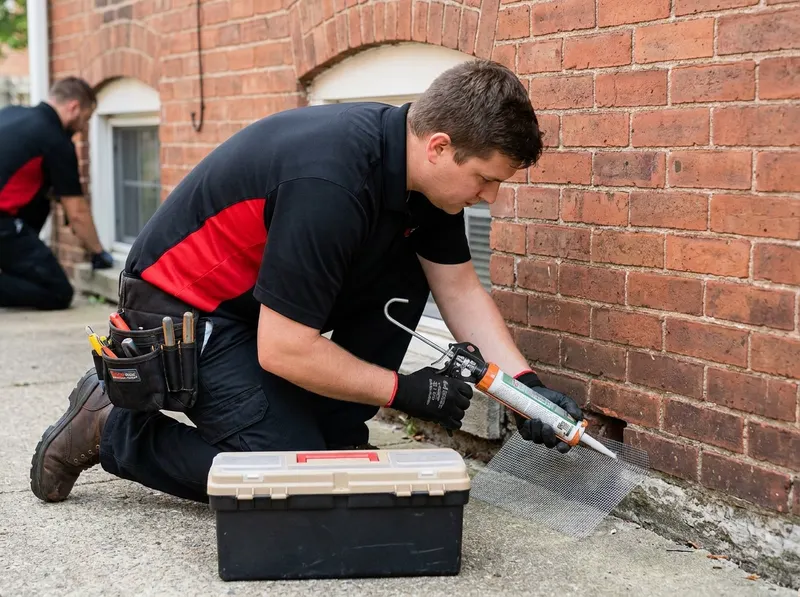
    Step 3: Physical barrier sealing using 19-gauge welded hardware cloth, metal escutcheon plates, and non-corrosive metals adhering to Occupational Safety and Health Administration safety protocols for confined spaces.

    Step 4: Attic and crawlspace bio-remediation, applying botanical sanitation agents to neutralize urine markers according to standards outlined by the Ohio Department of Health.

    Step 5: Follow-up sensor and trap verification across a 7-to-14-day window to confirm zero biological activity before final barrier sign-off.

Deciding between routine trap-setting and full-envelope exclusion involves balancing immediate disruption against permanent containment. Interior trapping alone removes the current rodent population within 5 to 10 days, but leaving the architectural envelope open guarantees re-infestation within the same seasonal cycle, as documented by the Ohio Department of Agriculture. Whole-structure exclusion requires an upfront investment in carpentry and mason sealing, but eliminates perpetual monthly maintenance costs. Field protocols adhere strictly to technical manuals published by the Ohio State University Extension, wildlife handling standards established by the Ohio Division of Wildlife, and general structural sanitation regulations enforced by Cincinnati Public Health. Property owners coordinate direct service consultations by calling (513) 812-8078.

How much does Comprehensive Rodent Control and Exclusion cost in Cincinnati?

Targeted Entry-Point Sealing (up to 2 exterior penetrations)$200 - $350
Standard Residential Interior Trapping & Monitoring Program$250 - $450
Full Exterior Envelope Exclusion (Single-Family Residential, under 2,000 sq ft)$450 - $1,200
Extensive Historic Foundation Exclusion & Attic Remediation (Over 2,000 sq ft)$1,200 - $2,800

Every job gets a firm, written price after an on-site visit.

Common questions

How much does rodent exclusion cost in Cincinnati?
Rodent exclusion in Cincinnati ranges from a $200 minimum charge for targeted entry-point repairs up to $2,800 for multi-story historic foundations requiring extensive masonry and flashing restoration. Exact pricing is confirmed on-site following an attic-to-basement structural inspection.
How quickly can rodent trapping clear an active mouse infestation in Cincinnati?
Interior mechanical trapping typically eliminates an active indoor mouse colony within 5 to 14 days when traps are configured along active biological runs. Total control is achieved once exterior structural exclusion prevents replacement populations from entering.
Why are rodents entering my Cincinnati home during late autumn?
Rodents enter Cincinnati homes between October and December as nighttime temperatures drop below 45 degrees Fahrenheit and outdoor food supplies diminish. Commensal rodents exploit foundation gaps, deteriorated crawlspace screens, and weathered garage seals seeking warmth and nesting materials.
Are rodent exclusion materials safe for pets and children in Cincinnati properties?
Physical exclusion materials consist of galvanized hardware cloth, copper wire mesh, silicone, and exterior sheet metals, presenting zero toxicity hazards to pets or children. When internal traps are necessary, technicians place them inside locked, tamper-resistant station housings.
Do historic homes in Cincinnati neighborhoods like Over-the-Rhine need specialized rodent proofing?
Historic homes in Cincinnati require specialized rodent proofing due to soft lime mortar, fieldstone rubble foundations, and complex shared party walls that permit rodent migration. Exclusion in these properties requires masonry-compatible compounds, customized metal threshold plates, and specific sub-floor void sealing.

Get started today

Tell us about your comprehensive rodent control and exclusion job in Cincinnati and we'll send a clear, written quote, usually the same day.

Get your PEST CONTROL SEVICE quote, Cincinnati

We only use your ZIP to check availability, no spam.